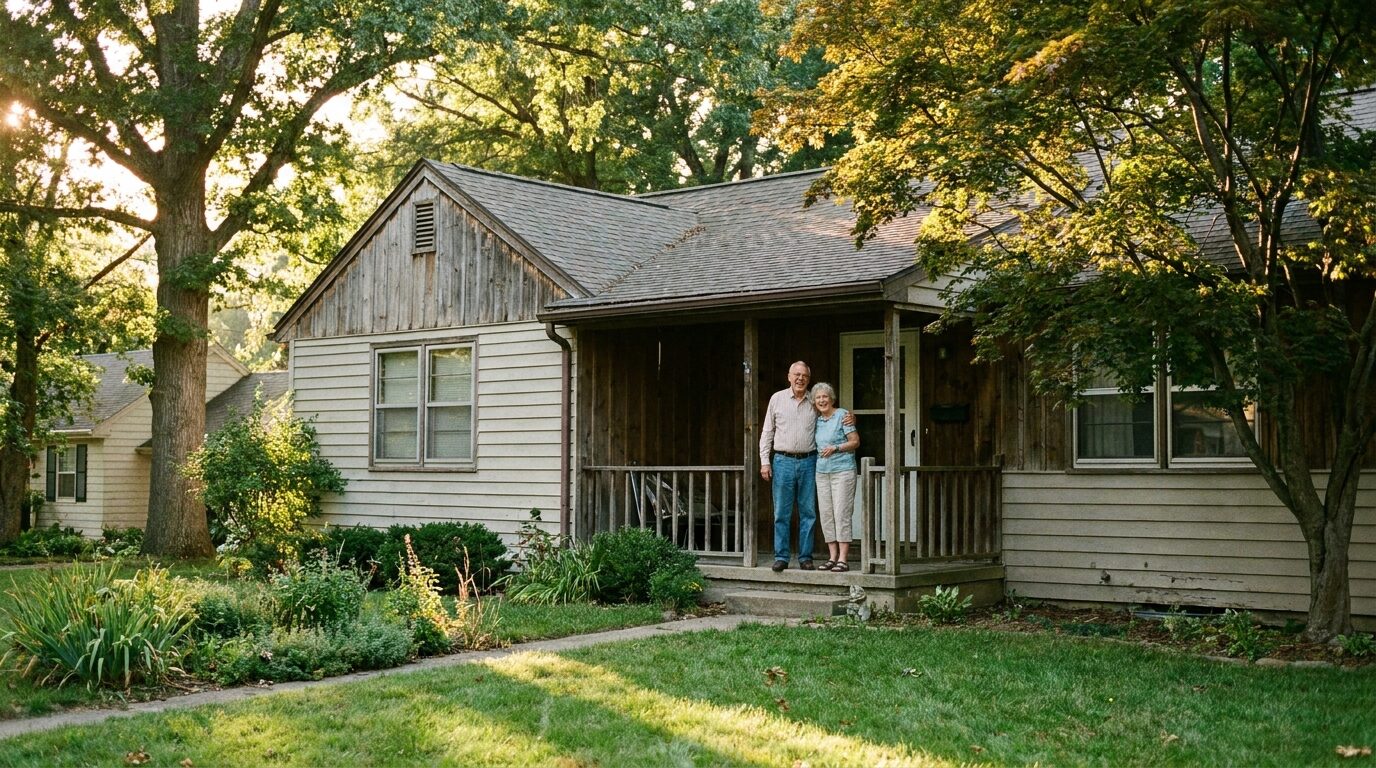
Most states offer some form of property tax break for homeowners 65 and older, but there’s no single national program — every state (and often every county) sets its own age cutoff, income limit, and savings amount. If you’re 65 or close to it, the fastest way to save money is to check your state revenue department or county assessor’s website directly, because the dollar figures below vary widely and change from year to year.
Why this isn’t a federal benefit
Property tax is a local and state tax, not a federal one, so there’s no IRS program that reduces what you owe your county. The federal government’s only real connection is the SALT deduction cap on federal income tax returns (currently $10,000 for state and local taxes combined, per IRS.gov), which has nothing to do with senior status. Every actual senior property tax break — exemption, freeze, credit, or deferral — comes from your state legislature or your county assessor’s office. That’s why the same 68-year-old homeowner might save $2,000 a year in one county and nothing in another county twenty miles away.
The four common types of relief
States tend to use one or more of these four tools. Knowing which type your state offers tells you what to ask for when you call the assessor.
| Type | How it works | Typical age | Income limit? |
|---|---|---|---|
| Additional homestead exemption | Reduces the taxable (assessed) value of your home by a flat amount or percentage on top of the regular homestead exemption | 65 | Sometimes |
| Assessment freeze | Locks in your home’s assessed value at a certain year, so future value increases aren’t taxed even as market value rises | 65 | Often, yes |
| Circuit breaker credit | A refund or credit tied to how much of your income goes to property tax, regardless of home value | Varies, sometimes no age requirement | Almost always, yes |
| Tax deferral | Lets you postpone paying some or all property tax until the home is sold or the owner passes away, with interest accruing | 60–65 | Sometimes |
An exemption lowers your bill every year you qualify. A freeze protects you from future increases but doesn’t necessarily lower what you’re paying now. A circuit breaker is the most targeted — it helps lower-income seniors most, since it directly compares tax owed to income. A deferral doesn’t erase the debt; it just delays it, and the state or county puts a lien on the home until it’s repaid.
What a few states actually do
These are real, named programs so you know what to search for, but always confirm current dollar figures and 2026 income thresholds on the official site listed in Sources — legislatures adjust these numbers almost every year.
Texas. Homeowners 65 and older get an additional $10,000 exemption from their home’s value for school district taxes, on top of the regular homestead exemption. Texas also offers a school tax “ceiling” for seniors, meaning your school property tax bill generally can’t increase above what it was the year you turned 65, even if your home’s value goes up, according to the Texas Comptroller of Public Accounts.
Florida. Counties and cities can adopt an additional homestead exemption of up to $50,000 for homeowners 65 and older whose household income falls under a limit set annually by the state (adjusted for inflation each year), per the Florida Department of Revenue. Some counties also offer a “long-term resident senior exemption” for people who’ve lived in the same home for 25+ years and meet the income test.
New York. The Senior Citizens Homeowners’ Exemption (SCHE) can reduce the assessed value of a home by up to 50% for owners 65 and older who meet an income limit, which is set locally and varies by county and by New York City, according to the NY Department of Taxation and Finance. New York also has the Enhanced STAR program, which increases the standard STAR school tax exemption for seniors who meet income requirements.
California. California doesn’t have a broad flat-dollar senior exemption, but two tools matter here. Proposition 19 lets homeowners 55 and older transfer their existing (often lower) assessed value to a new home purchased anywhere in the state, up to three times in their life, protecting them from a big reassessment jump when they downsize or relocate. Separately, the state’s Property Tax Postponement Program, run through the State Controller’s Office, lets eligible seniors (62+) and people with disabilities defer current-year property taxes on their primary residence if they meet income limits, with the deferred amount plus interest owed later.
Washington State. The Senior Citizen and Disabled Persons property tax exemption reduces or freezes the assessed value for homeowners 61 and older whose income falls below a limit tied to the county’s median household income, so the threshold differs by county, according to the Washington Department of Revenue.
These five states show the pattern: age around 60–65, income limits that vary by locality, and a mix of flat exemptions, freezes, and deferrals. Most other states use some version of the same tools — check yours.
How to find out what your state offers
- Search “[your state] senior property tax exemption” plus “.gov” to land on the official state revenue or taxation department page rather than a third-party site.
- Call your county assessor’s office. Exemptions are usually administered and applied for at the county level even when the program is authorized by the state.
- Ask about stacking. Many seniors qualify for a regular homestead exemption plus a senior add-on plus a disability exemption if they qualify for more than one — these can often be combined.
- Ask what counts as income. Circuit breaker and income-limited exemptions often count Social Security benefits, pension income, and investment income differently than your federal adjusted gross income does. Some states exclude Social Security from the income test entirely; others don’t.
How to apply — the general steps
While forms differ by state, the process is fairly consistent:
- Confirm you meet the age requirement as of a specific date, often January 1 or your birthday in the tax year — not just “sometime this year.”
- Gather proof of age and residency, usually a driver’s license or state ID showing your home address, plus a deed or tax bill proving ownership.
- Gather proof of income if the program has an income limit — tax returns, Social Security benefit statements (SSA-1099), and pension statements are common.
- File the exemption application with your county assessor, not the state, in most cases. Deadlines are often tied to the local tax year, commonly sometime between January and April, so don’t wait until your tax bill arrives.
- Renew or reconfirm eligibility if your state requires it. Some exemptions are one-time filings that stay in effect until you sell or move; others require annual re-certification of income.
- Watch for automatic renewal notices. Some counties send a card each year that you must sign and return, or the exemption drops off your bill without warning.
Common mistakes to avoid
A freeze is not a discount. If your county freezes your assessed value at $250,000, you can still see your tax bill go up if the local tax rate (millage rate) increases, even though the value itself stays flat. A deferral is not free money. The deferred tax still has to be repaid, usually with interest, when the home is sold or transfers to an heir — this can shrink what’s left for your estate. Missing the filing deadline usually means waiting a full year to reapply; assessors rarely accept late applications for the current tax year. And moving doesn’t automatically carry your exemption with you — in most states you must reapply at your new address, though states like California with Prop 19 portability are an exception.
Sources
- IRS.gov — general federal tax rules, including the SALT deduction cap
- Texas Comptroller of Public Accounts — comptroller.texas.gov
- Florida Department of Revenue — floridarevenue.com
- New York State Department of Taxation and Finance — tax.ny.gov
- California State Controller’s Office — sco.ca.gov
- Washington State Department of Revenue — dor.wa.gov
Do I have to be fully retired to qualify for a senior property tax exemption?
No. Most states base eligibility on your age (commonly 65, sometimes 61 or 62) and, if applicable, your income — not your work status. You can still be working part-time and qualify, as long as your total household income falls under the limit your state or county sets.
Can I get a senior exemption and a veteran’s or disability exemption at the same time?
In many states, yes. Exemptions for seniors, veterans, and people with disabilities are often separate programs that can be combined, though a few states cap the total reduction or require you to choose the larger benefit rather than stack all three. Ask your county assessor directly, since the stacking rules are set locally.
What happens to my exemption if I move to a new home?
In most states, the exemption stays with the property, not with you, so you’ll need to reapply at your new address and requalify under that county’s rules. California is a notable exception: under Proposition 19, homeowners 55 and older can transfer their existing assessed value to a new primary residence anywhere in the state, up to three times, which can prevent a big tax increase when downsizing.
Related reading
- Social Security COLA for 2026: How Much Bigger Will Your Check Be?
- Medicare Open Enrollment: Dates, What You Can Change, and Costly Mistakes
- Medicare Advantage vs Original Medicare: A Plain-English Comparison