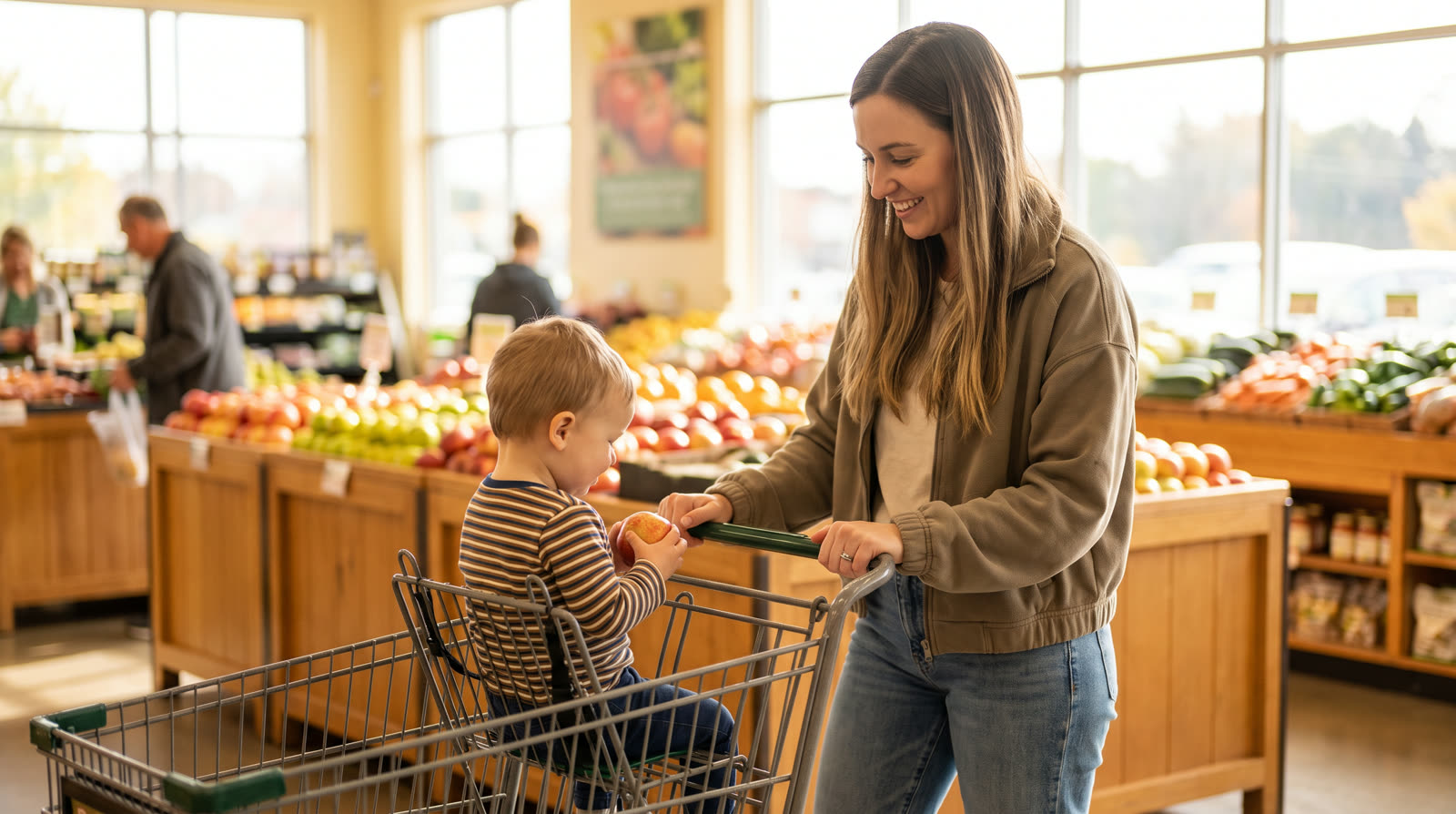
WIC benefits buy specific foods on a state-approved list — not whatever you want at the grocery store. The core categories are milk, cheese, eggs, whole grains, juice, beans or peanut butter, infant formula and baby food, and a cash allowance just for fruits and vegetables. Exactly which items and how much depends on who’s in the household (infant, child, or pregnant/breastfeeding parent) and which “food package” USDA assigns to that person.
Why WIC Uses a Fixed Food List Instead of Cash
WIC stands for the Special Supplemental Nutrition Program for Women, Infants, and Children, and unlike SNAP, it was never designed as general grocery money. Congress created it in 1972 to fix specific nutrition gaps — iron, calcium, protein, vitamin C — identified in low-income pregnant women and young children. The program still works that way: USDA’s Food and Nutrition Administration (FNA) — the agency formerly known as the Food and Nutrition Service — sets national food packages tied to nutritional need, and each state WIC agency then builds an “Approved Product List” (APL) of exact brands, sizes, and types that count, according to USDA.gov.
That’s why the cashier scans your WIC card and some things ring up, others don’t. It’s not arbitrary — it’s the state matching your benefit categories against its approved list in real time.
The Seven WIC Food Packages
USDA assigns participants to one of several packages based on age and status. Here’s the breakdown, using USDA’s standard package numbering:
| Package | Who it’s for | What it generally includes |
|---|---|---|
| I | Infants 0–5 months (fully formula-fed, partially breastfed, and fully breastfed) | Infant formula for formula-fed and partially breastfed infants |
| II | Infants 6–11 months | Formula, infant cereal, infant fruits/vegetables |
| III | Women, infants, and children with a qualifying medical condition | Exempt infant formulas and WIC-eligible nutritionals, plus authorized WIC foods as prescribed |
| IV | Children 1 through 4 years | Milk, eggs, whole grains, breakfast cereal, juice, legumes/peanut butter, canned fish, fruits & vegetables cash benefit |
| V | Pregnant women (V-A) and partially (mostly) breastfeeding women (V-B), up to 1 year postpartum | Milk, eggs, whole grains, juice, legumes and peanut butter, canned fish, fruits & vegetables cash benefit |
| VI | Postpartum women who are not (or are minimally) breastfeeding, up to 6 months postpartum | Smaller quantities than Package V — e.g., 16 quarts of milk, 10 oz canned fish, legumes or peanut butter |
| VII | Fully breastfeeding women, up to baby’s first birthday | Largest package — the most canned fish (20 oz), a separate cheese allowance, 2 dozen eggs, and the top fruit/vegetable benefit (shared with partially/mostly breastfeeding participants) |
Fully breastfeeding mothers get the most generous package on purpose. USDA’s long-standing policy is to make breastfeeding the easier, better-supported choice, so a mom who skips formula gets more food value in return, not less.
What Actually Lands in Your Cart
Within those packages, here’s what shows up at checkout:
- Milk: whole milk for children 1–2, then low-fat (1%) or fat-free after age 2 (2% reduced-fat only when medically indicated); soy and other plant-based milk alternatives, and lactose-free milk, can generally be substituted without medical documentation.
- Eggs: one dozen fresh shell eggs — not egg substitutes. Allowed sizes and colors are set by each state’s approved product list, and many states authorize white or brown eggs in a range of sizes.
- Cheese: a specific monthly allowance of approved block or sliced cheese, used in some packages instead of part of the milk allotment.
- Whole grains: whole wheat bread, brown rice, corn tortillas, whole-grain pasta, or oats — the item must be on the state’s whole-grain list.
- Breakfast cereal: must meet a minimum whole-grain content and a maximum sugar content set by USDA; a limited number of approved brands per state.
- Juice: 100% juice only, in specific container sizes, no cocktails or juice drinks.
- Beans, peas, or peanut butter: dried or canned beans/peas, or peanut butter, as a protein source.
- Canned fish: light tuna, salmon, sardines, or mackerel — since the 2024 food package rule it is included for children 1 through 4 (6 oz) and for all women’s packages (10 oz pregnant/postpartum, 15 oz partially breastfeeding, 20 oz fully breastfeeding).
- Infant formula: a specific brand and type contracted by the state (states negotiate rebate contracts with one manufacturer, so the “WIC brand” varies by state).
- Infant cereal and baby food: iron-fortified infant cereal, and single-ingredient jarred or pouched fruits, vegetables, and sometimes meat for older infants.
- Fruits and vegetables (Cash Value Benefit): a dollar amount loaded onto the card each month to buy fresh, frozen, or canned produce — any variety, with no added sugar, fat, or salt.
That last one, the Cash Value Benefit (CVB), is the closest thing WIC has to “spend it on what you want.” For fiscal year 2027 (Oct. 1, 2026 through Sept. 30, 2027), the monthly CVB amounts are $27 for children, $48 for pregnant and postpartum participants, and $53 for fully and partially (mostly) breastfeeding participants — but these figures are indexed and can shift slightly each year, so confirm your exact amount with your state WIC agency or on USDA.gov before you shop.
What’s Off the List, and Why
A few common questions come up at the register:
- No organic premium automatically — organic produce, milk, and eggs are allowed if they’re on your state’s approved list, but WIC won’t cover a price difference beyond what the benefit allows.
- No store brands unless approved — many generics are on the APL, but not all; the WIC-eligible shelf tag or scanner is the only reliable check.
- No large egg cartons or jumbo sizes unless that’s the approved size — buying the wrong size will reject at checkout even if it’s the right food.
- No soda, candy, or snack food — the program is nutrition-targeted, so ultra-processed items never qualify regardless of state.
- No baby food pouches with added ingredients like yogurt blends or desserts — only single or simple combination purees typically qualify.
None of this is the cashier being difficult. The WIC card is programmed against the APL, and anything not on it simply won’t scan as WIC-eligible.
A Worked Example: One Family’s Monthly Package
Consider a mom who is partially breastfeeding her 4-month-old and has a 3-year-old also on WIC.
- The infant is on Package I until 6 months and moves to Package II at 6 months, drawing partial formula; the mother’s own package is enhanced because she is breastfeeding.
- The mother, on Package V-B as a partially (mostly) breastfeeding woman, might receive: up to 22 quarts of milk, 1 dozen eggs, 48 ounces of whole-grain bread or equivalent, 18 ounces of peanut butter and 1 pound of dried beans (she gets both), 64 fluid ounces of juice, 15 ounces of canned fish, and $53 in Cash Value Benefit for produce.
- The 3-year-old, on Package IV, gets a scaled-down version: up to 16 quarts of milk, 1 dozen eggs (cheese only as a substitution for part of the milk), whole-grain bread, 64 fluid ounces of juice, and $27 in produce benefit.
Combined, that family might carry close to $75–$90 a month in produce-only value, plus the hard-good staples above. The exact quarts, ounces, and dollar figures are set by the state agency and printed on the benefit balance the family can check via the state’s WIC app or a receipt-style printout after each purchase — according to USDA.gov’s WIC program pages.
Finding Your State’s Approved List Before You Shop
Because every state runs its own APL, the fastest way to avoid a rejected item at checkout is to check ahead of time:
- Log into your state WIC agency’s app or website (most states, like California’s WIC or Texas WIC, publish a searchable APL).
- Use the WIC shopping app if your state offers one — many scan a barcode and tell you instantly if an item qualifies.
- Keep your benefit balance printout or app screen handy; it lists exactly what’s left to buy this month by category.
- Ask your WIC clinic for a printed “WIC Food List” booklet — most local agencies hand these out at certification appointments.
Frequently Asked Questions
Can I buy organic milk or produce with WIC?
Usually yes, if the specific organic product is on your state’s approved list. Organic options are increasingly added to APLs, but coverage isn’t universal, so check your state list or app before assuming an organic item will scan.
Does WIC cover formula if my baby has an allergy?
Yes, but it requires documentation. Standard contract formula is covered automatically; specialized or hypoallergenic formulas (like amino acid-based formulas) require a medical statement from your baby’s doctor, and your state WIC agency issues a separate, medically tailored food package, according to USDA.gov.
Can I use WIC and SNAP benefits in the same shopping trip?
Yes. They’re separate benefits that use separate cards, but nothing stops a household from using both at checkout. Many stores ring up WIC items first, then let you pay the rest of the order with SNAP or another payment method for non-WIC groceries.
Sources
- USDA Food and Nutrition Administration, WIC Program: https://www.fna.usda.gov/wic
- USDA WIC Food Packages (regulatory overview): https://www.fna.usda.gov/wic/food-packages
- USDA WIC Eligibility: https://www.fna.usda.gov/wic/eligibility
- USDA WIC Breastfeeding Support: https://www.fna.usda.gov/wic/breastfeeding
Related reading
- Social Security COLA for 2026: How Much Bigger Will Your Check Be?
- Medicare Open Enrollment: Dates, What You Can Change, and Costly Mistakes
- Medicare Advantage vs Original Medicare: A Plain-English Comparison